

Star-Kept Lovers

I’ve always loved the stars.
Not because I know much about astronomy. I don’t. I can find The Plough, but I couldn’t confidently point out Orion or Cassiopeia without my faithful Night Sky app and an embarrassingly long pause.
What I love are the stories.
The idea that, for thousands of years, people have looked up at the same scattered points of light and woven them into something meaningful. Individual stars, separated by impossible distances, becoming bears, hunters, queens and farming equipment because somebody imagined they belonged together.
I’ve always loved the idea of astrology too.
The thought that our lives begin beneath a particular sky has always fascinated me. Not because I believe our futures are fixed, far from it, but because the stars themselves are never still. They shift; they disappear behind clouds and return. Our lives do the same. We aren’t bound by the sky we were born under, only invited to begin there. Our lives resemble constellations more than horoscopes: not one spectacular moment, but thousands of ordinary moments, gradually joined together until they become a story.
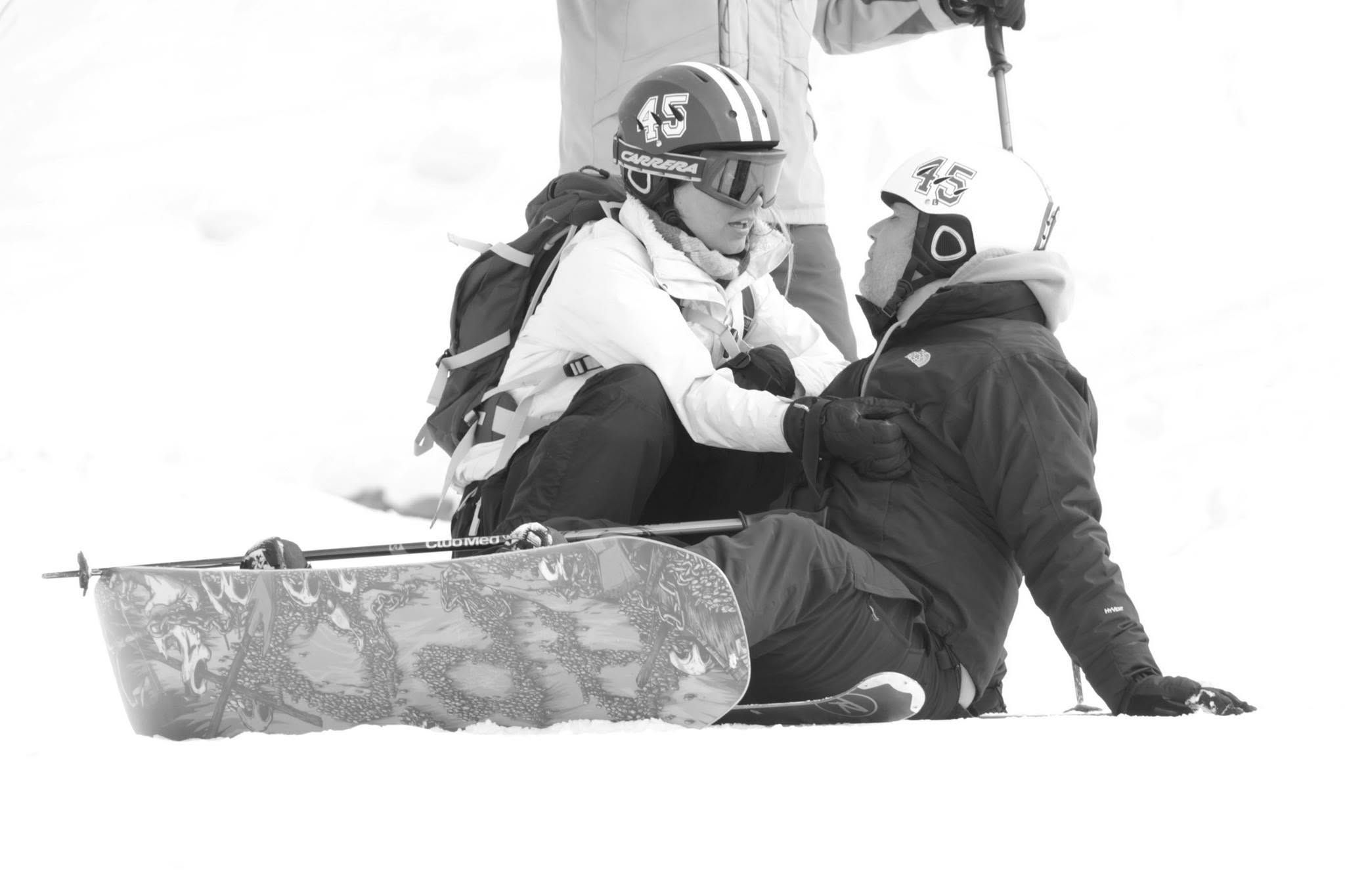
When I first met my husband, I was eighteen and he was twenty-three. We met in a bar in Chamonix called Wild Wallabies. The name alone should probably have warned me. He apparently first noticed me attempting to ride the bucking bronco.
Attempting...
I lasted only a few seconds before being unceremoniously thrown off, taking most of my dignity with me. What I didn’t know was that he’d been watching from across the room, playing pool with his friends; what he didn’t know was that I’d noticed him long before I climbed onto that infernal bucking bronco. Funny, isn’t it, how two people can remember the same evening from opposite sides of a room?
As soon as I was ejected from the saddle, he wandered over, asked if I’d play doubles with him and offered to buy me a beer. Looking back, I often think about how ordinary that evening seemed. Boy meets girl, and nobody in that noisy bar, least of all us, knew they were watching the first page of a story that would still be unfurling thirty years later.
Life contains moments like that. I call them fateflickers. Moments that barely shimmer as they happen before dividing everything into before and after.
That night, he told me he was going to marry me. He now denies it completely. Memory, it seems, is far kinder to twenty-three-year-old men than the men themselves. Unfortunately for him, I’ve spent my career teaching English. I know good evidence when I hear it.
Besides, he has form.
Many years later, at a R.A.F ball, we entered a raffle with hundreds of tickets. Before the compère had even reached into the drum, my husband stood up and announced, quite matter-of-factly, “We’ve won, Claire.” A few moments later, our number was called! He was already halfway to the stage before anyone else had realised what was happening.
He’s strange like that. Quietly certain about things he has no earthly business being certain about.
The mountains around Chamonix seemed mammoth back then. The world felt impossibly large, as though adventure waited beyond every snow-covered ridge. By day, he disappeared onto the slopes with his snowboard mates while I clung to rock faces, climbing mountains rather than sliding down them. Every evening we’d find each other again in Wild Wallabies, each carrying a day’s worth of stories: snow, rock, near misses, pool and laughter. I beat him far more often than his ego considered reasonable.
He drank beer.
I drank rum.
A little too much rum.
We were wonderfully untamed back then. The sort of young adults who believed life, and destiny, were things to trust rather than carefully plan. If that’s reckless, so be it.
He came from a world very different to mine. His childhood had been shaped by fracture, mine by tradition. He called me his Uptown Girl, usually with just enough affection disguised as sarcasm to suggest my upbringing fascinated him far more than it impressed him. Yet beneath all those differences, there was a strange feeling we’d met before. Not in any literal sense, just the quiet recognition that sometimes arrives when another soul feels oddly familiar.
Neither of us had come to Chamonix looking to be sensible. We had both been bruised before, carrying stories we didn’t usually hand to complete strangers. Yet somewhere between the beer and the rum, beneath a sky stitched with stars, walking streets so cold they should have frozen every sensible thought, the first quiet crescence of us took root. We started handing those stories to each other.
The mistakes.
The regrets.
The parts of ourselves we weren’t especially proud of.
I remember him talking honestly about the twists and turns that had brought him there, and although I can’t remember exactly what I said in return, I remember the relief of meeting someone who wasn’t pretending to have everything figured out. There was no performance, no carefully edited version, just two young people who already knew honesty was far more attractive than perfection. By the time we left the bar, the temperature had dropped well below freezing. I was wearing nothing but jeans and a jumper, yet I wasn’t cold. Rum has remarkable insulating qualities. Or just maybe some moments simply burn hotter than the weather surrounding them.
As we walked beneath that impossible Alpine sky, I remember looking up and slowly spinning beneath the stars, the whole universe wheeling above my head. There was scarcely enough night left to hold the stars.
Then he kissed me.
For one dizzying moment, I couldn’t have told you whether it was the rum, the altitude or the kiss that tipped the world off its axis. I only knew that it had.
I cannot tell you what he said after the kiss!
There will always be some secrets, and some memories aren’t interested in transcripts anyway. Memory is interested in feeling.
That feeling of certainty raced through me, that, despite every reason we probably shouldn’t work, neither of us wanted to walk away in that moment. Our reckless confidence that whatever came next, we’d find a way through it. I thought love would arrive with the brilliance of a shooting star: bright, breathtaking and unmistakable. It took me nearly thirty years to realise the real miracle was never the stars above the Alps. It was our constellation, clandestinely forming above us long before either of us knew where it would lead.
The heavens had one final surprise for us that March we met.
A comet: Hyakutake.
We met just as one of the brightest comets of the twentieth century swept past Earth. It hung above the Alps, impossibly luminous against the fading night. Its Japanese name translates as one hundred mountain peaks. Often reality tells the better story than fiction.
During that magical time, we roambled across the Alps. I was a bit of a hitchhiker then, happily scattering myself between ski resorts with little more than a backpack and a vague plan. Somewhere along a mountain road we pulled over, climbed out of the car and stood, hushstruck, beneath the comet. It was there that he confessed the only book he’d ever read was The Hitchhiker’s Guide to the Galaxy.
As someone who already carried Shakespeare, the Brontës and a head full of stories wherever I went, I remember rolling my eyes in theatrical despair. How could anybody reach the age of twenty-three having read just one book? I’ve since learnt that while I searched the heavens for poetry, he was perfectly content with a world where the answer to life, the universe and everything was simply 42.
He became a systems architect.
I became an English teacher.
Scientists tell us Hyakutake, the comet that became the first point of reference in our constellation, won’t return for another seventy thousand years.
I rather like that thought.
A few years later, on the other side of the world, we found ourselves doing the same thing.
Looking up.
Before Australia came Asia.
One stop was Langkawi.
By day we chased waterfalls, sailed catamarans and wandered wherever curiosity led us. By night we sat on moonlit beaches, drinking rum, swatting Jurassic-sized insects with limited success and smothering ourselves in Tiger Balm, the universal perfume of backpackers being eaten alive.
One afternoon we climbed to Telaga Tujuh, the Seven Wells Waterfall. Legend says seven celestial nymphs descended after dark to bathe in its pools, vanishing the moment they sensed human footsteps. The locals spoke of it matter-of-factly, as though the boundary between the ordinary and the extraordinary had always been a little thinner there. I’ve always collected stories more eagerly than souvenirs, so naturally I brought home both the legend and the photograph.
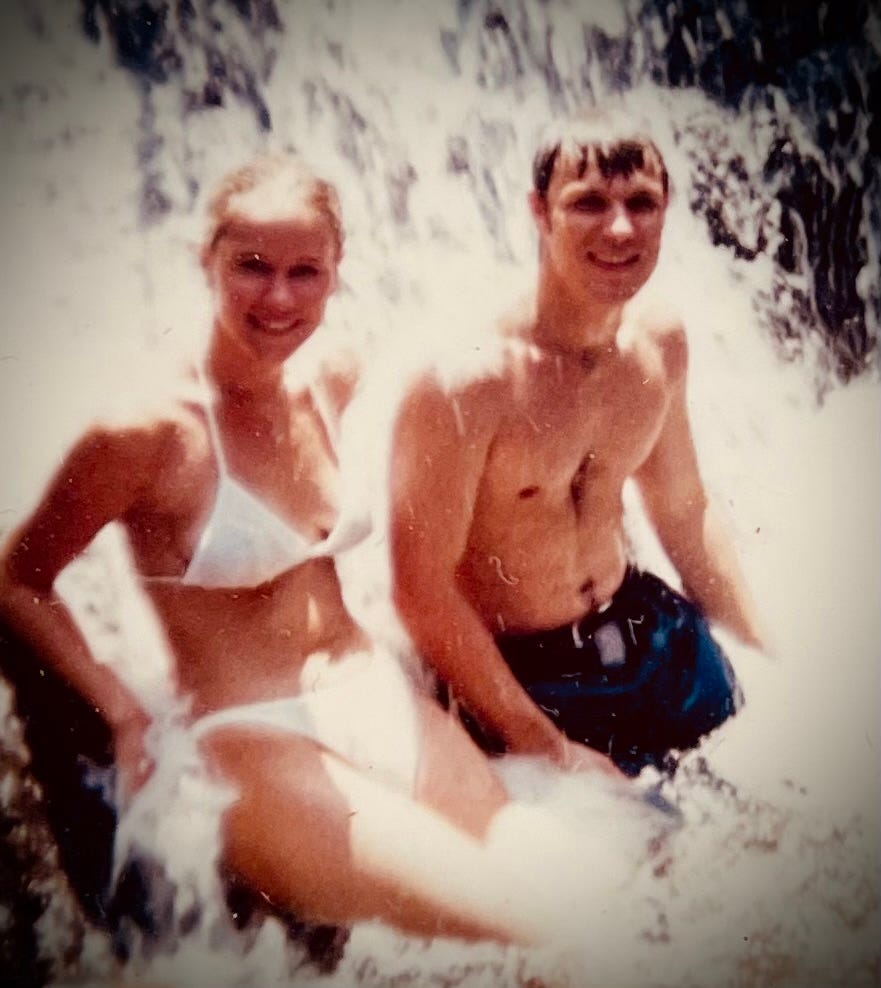
Looking back, I realise our marriage has done the same, gathering stories that remind us of who we were when they found us.
Australia made us feel smaller still.
We drifted from boat to boat, sailing south from Cairns towards the Whitsundays, sleeping on deck beneath Southern Hemisphere skies so vast they seemed to begin where Earth ended. Days were measured by tides, coral reefs and the tail end of tropical storms. There was nowhere to be except exactly where we already were.
For over a fortnight we sailed the Great Barrier Reef aboard a fifty-two-foot concrete ketch called Severance.
Even now, that name makes me smile.
Hardly the vessel you’d choose if reassurance ranked highly on your list of priorities. Then there were the posters plastered around backpacker hostels, warning us not to disappear over the horizon with persuasive strangers beneath the wonderfully comforting slogan:
At sea, no one can hear you scream.
Not exactly the words you want rattling around your head as you cast off with Calico Jack.
Our skipper was an elderly gentleman trying to sail Severance to Brisbane for his son, who was in hospital. He needed someone capable of lowering an anchor that appeared to weigh almost as much as a family car. In those days my husband looked the sort who could moor the Titanic, which was unfortunate because Titanic was the last film we’d watched before setting sail.
Before long, my poor man was hauling anchors, fixing the skipper’s mistakes and catching our dinner, while I clung to the galley sink, chopping salad and trying not to donate any fingers to the fish. We learned ropes, watches and tides as we went.
There were moments when I wondered if we’d ever see land again. We anchored beside story-soaked Aboriginal islands where children hurled themselves from rocks into impossibly clear water while the Elders made it gently, but unmistakably, clear that we were visitors.
It was exhilarating.
Humbling.
The world felt ancient.
And we were wonderfully small within it.
Yet every night, when darkness settled across the ocean, something inside me settled too.
Wrapped in strong arms, with nothing above us but stars and nothing beneath us but the Coral Sea, I felt safer than I had any right to. Looking back, it seems extraordinary that such a precarious place should become one of my safest memories. Above us, unfamiliar constellations wheeled across the Southern Hemisphere. Different stars. The same feeling. We counted shooting stars until sleep claimed us. Seventeen, I think. I don’t remember what we ate, whether music was playing, or even if it was playing at all. Memory edits without asking permission. It sweeps away practical details to make room for what mattered most.
When we finally reached dry land, we briefly debated whether to desert our skipper before he made it to Brisbane. There was absolutely no prospect of me getting back on that boat.
Instead, we headed for the cinema. I needed to remain steady for a time on something that didn’t move.
Shakespeare in Love or Armageddon.
Armageddon won.
Not because my husband had suddenly discovered his inner romantic. As if. He was far more interested in asteroids, spacecraft and whether any of the science was remotely plausible than Shakespeare. I was simply happy to sit beside him while Aerosmith promised we wouldn’t Miss a Thing. Looking back, it wasn’t the asteroid that stayed with me, but the relief when The Freedom crew finally made it home. After a fortnight aboard Severance, I understood that feeling rather well.
Once again, even indoors, I found myself looking up at the stars.
Another star in our constellation.
Of course, constellations aren’t made from two or three stars. They’re traced from hundreds, sometimes thousands, of points of light. So it is with a life together. Ours isn’t stitched together by facts so much as moments and feelings. Tiny, ordinary moments that, with enough distance, begin to reveal a pattern.
Our constellation kept growing.
Rocket launches at Christmas and kitchen tables.
Total eclipses and breakups.
House moves and harvest moons.
Aurorae painting pink the skies above dark dog walks.
Birthdays and blue moons.
Extraordinary adventures.
Ordinary days, quietly becoming extraordinary.
I couldn’t possibly tell you about every star. Memory wouldn’t let me. It has already chosen the ones it wants me to keep.
When people ask how long we’ve been together, I usually give them a guesstimate.
Over three decades.
It sounds impressive when I say it aloud, as though long marriages simply arrive because enough years have passed.
They don’t.
They accumulate.
A look exchanged across a room because one of the children has just said something unintentionally hilarious. A secret smile. Knowing which version of “I’m fine” is actually fine, and which one needs a cup of tea and a quiet five minutes. He reminds me where I left my glasses. I remind him what day it is and where he left his keys and wallet. I’m a social butterfly. He insists he doesn’t really like people. “I like you,” he says. “And Red.” I’m still not entirely convinced I come first. We’ll ask each other what we’ve got left in the tank. It’s never fifty-fifty. Some days it’s eighty-twenty. Others it’s thirty-seventy. Whoever has more simply says, “I’ll cover you.”
Whole conversations now happen in raised eyebrows, unfinished sentences and references nobody else could possibly understand. The grown children occasionally look at us as though we’ve slipped into another dimension before begging us not to speak like that in front of their friends because, apparently, “people will think you’re weird.”
They’re probably right.
That’s marriage.
Not fifty-fifty. Just whatever it takes to make a whole.
Romance changes too.
At eighteen, I imagined it would always be moonlight and shooting stars, stolen kisses and pillow talk. At forty-eight, romance looks like nasal strips and two cooling mats laid side by side on our pillows; one for his overenthusiastic thyroid, one for my spectacularly uncooperative perimenopause. Nobody writes sonnets about hormonal temperature regulation. Perhaps they should. Perhaps I should!
Then life, as it inevitably does, introduced weather.
Not the kind that rolls across the Lincolnshire Wolds. The other kind. Parents become ill. Children grow up. Money occupies conversations it was never invited into. Grief arrives carrying paperwork that was never yours to begin with. Plans are rewritten. There are seasons determined to outstay their welcome. Sometimes we’ve become so busy studying the weather that we’ve forgotten to look up.
Yet constellations never really disappear. The stars remain exactly where they were. It is only our view of them that becomes obscured.
Looking back, I realise love was never really the shooting stars. It wasn’t the Alps or the comet, or the moonlit beaches. Those memories are still breathtaking, but they were never the whole sky.
I no longer notice where he begins any more than I notice where the sky ends and the horizon starts. The boundary is still there, I suppose, but after long enough your eyes stop looking for it. You simply live inside it. His joys alter the weather inside me. My grief echoes through him. We carry each other’s histories so instinctively now that remembering has become a shared occupation.
When I think about my wonderful dad, I cannot do it without hearing my husband trying not to cry before I’d even finished telling him what had happened. I remember saying, through my own tears, “Don’t cry. Joe’s standing right beside you.” It wasn’t that I didn’t want him to cry. Somehow, from two hundred miles away, I was trying to hold everybody together with nothing but my voice. My parents in London. My family in Lincolnshire. An invisible thread stretched so tightly, yet somehow it held.
That’s what thirty years gives you. Not certainty. Not perfection. Just the quiet crescence of two lives becoming one landscape.
One day, when the weather softens, we’ll build the firepit we’ve talked about for years. We’ll carry the telescope into the garden. I’ll insist that’s a shooting star. He’ll patiently tell me it’s a satellite. I’ll ignore him. We’ll drink hot chocolate with cream beneath a sidereal sky, still arguing gently about astronomy, the relevance of Shakespeare and whether the universe is governed by stories or mathematics.
Still joining the dots.
Oh this is lovely! My favorite: I call them fateflickers. Moments that barely shimmer as they happen before quietly dividing everything into before and after. I agree with this completely, though sometimes, at least in my life, these moments are defined by trauma. Thank you so much for sharing!
Beautiful 💖