
Lettres d’Amour
Tiny paper proof that we loved and were loved in return.

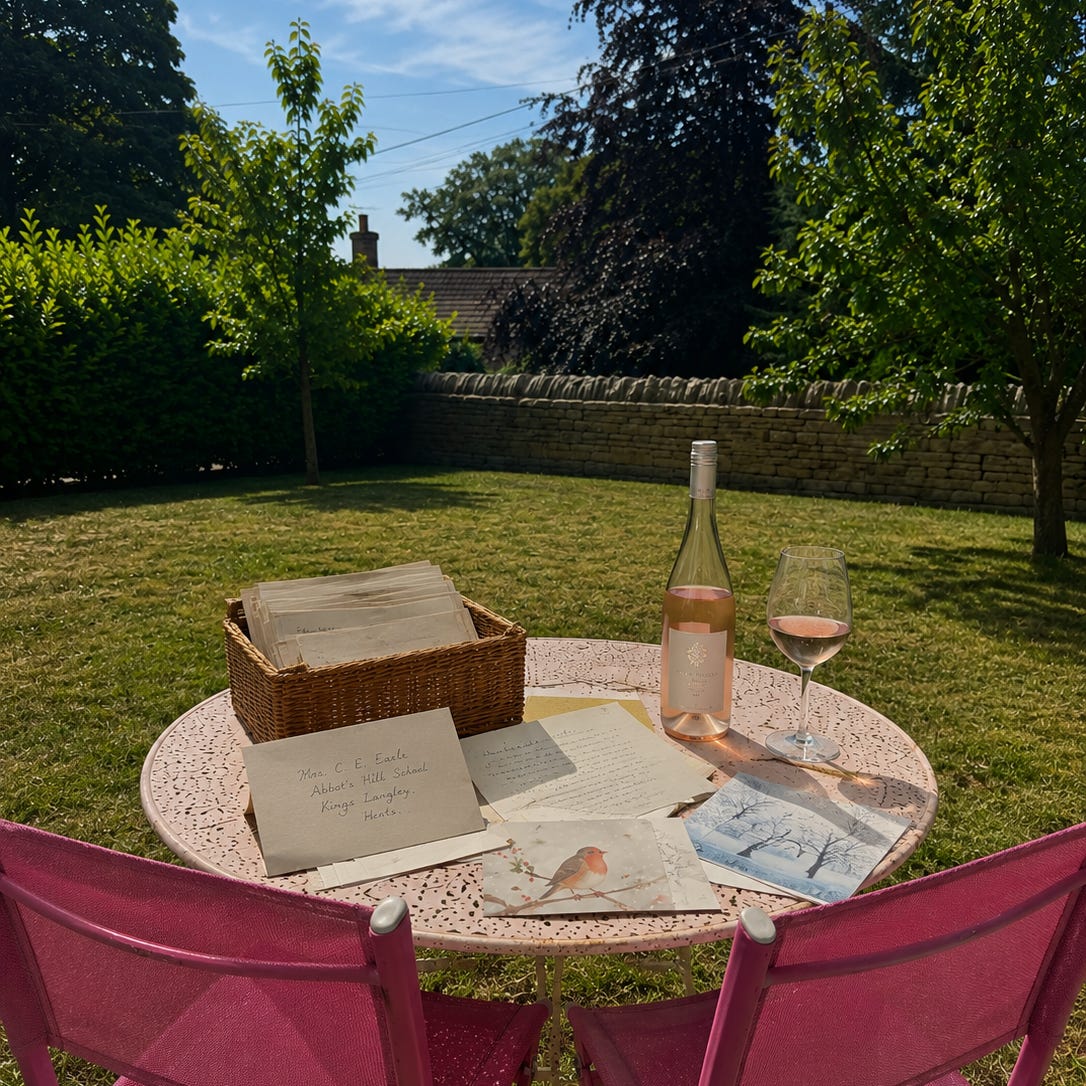
This birthday, I received so many beautiful cards.
Each carried a different inscription. Some contained a brief note signed with tons of love. Others held longer, heartfelt messages. The kind that makes you stop what you’re doing and read them twice. Sometimes thrice.
Some will inevitably end up balanced on windowsills and mantelpieces long after the cake has been eaten and the candles blown out. They are the ones that contain a message that makes us feel truly seen.
I’ve always been a stationery person.
As a child, WHSmith was my equivalent of Disneyland. I could spend hours either in the book section or standing in front of shelves of notebooks, searching for different coloured inks or a pad small enough to fit in my pocket.
While other children spent their pocket money on sweets, I was trying to decide whether I needed another notebook.
I always did.
I loved pens. The smell of freshly printed paper. Stickers. Bookmark tassels. Packs of highlighters and coloured gel pens that promised to transform my handwriting into something elegant and mysterious. I spent far too long examining diaries, address books and Filofaxes.
Especially Filofaxes.
If you grew up in the 1980s, you’ll understand.
A Filofax wasn’t just a diary. It was a lifestyle. A declaration of intent. Proof that you were the sort of person who had important things to write down and somewhere sensible to keep them.
I desperately wanted one.
Unfortunately, my budget was more “single biro and a soap shaped rubber” than luxury personal organiser.
So, I would stand there in WHSmith turning the pages, admiring the little tabs and see-through pockets as though I were browsing houses I couldn’t afford.
The first and only Filofax I ever owned was bought for me by my gorgeous husband because he knew how long I’d wanted one. I was in my early twenties by then. There was just something magical about them. The little tabs. The crisp pages. The infills. The possibility that if I owned the right Filofax, I might finally become the sort of organised person who remembered birthdays, completed tasks on time and generally had her life together.
Dear Substacker, I did not.
Still, that never stopped me looking.
These days everyone seems to organise themselves on their phones. I suspect half the children I teach have never owned an address book and would regard a Filofax with the same anthropological curiosity normally reserved for Stonehenge. But I loved anything that could help me organise my life, inform me, or give shape to the thoughts rattling around inside my head.
And believe me, there were a lot of thoughts to organise.
I was never particularly good at expressing myself aloud when I was younger.
I think I was an awkward child who spent far more time living in my imagination than in the real world. I would potterdrift through entire afternoons. Setting out with one clear task in mind, that is, to make rose petal perfume, of course, only to find myself following Dad around the garden collecting pebbles, building stories in the treehouse, naming imaginary animals, and wandering down entirely different paths while remaining convinced I was being productive. I was forever collecting pebbles, feathers, leaves, even snails! Little treasures with no obvious value beyond the fact they had somehow captured my attention.
Then there were my stories.
When I was about nine, my parents bought me a typewriter that became one of my most treasured possessions. It was gloriously 1980s, grey and pink, perfectly matched to my bedroom, and I adored it. Had I also owned a Filofax, I would have considered myself unstoppable.
In my imagination, I wasn’t just a child with a typewriter. I was the leading lady in The Secret of My Success. The sort of sophisticated young woman who strode purposefully through New York with a Filofax tucked under one arm, important meetings to attend, colour-coded plans to execute and, naturally, Michael J. Fox waiting to fall hopelessly in love with me.
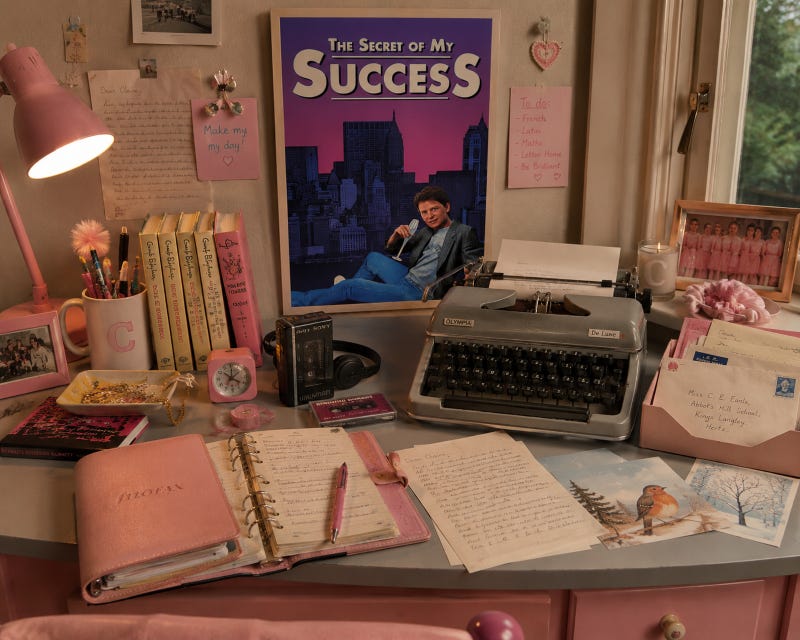
In reality, I was nine years old, wearing NHS glasses, covered in grass stains, collecting feathers and snails, and attempting to manufacture perfume from rose petals in the garden.
Thankfully, reality never seemed to spoil the fantasy.
I wish I knew where that typewriter was now.
I would often wake at five o’clock in the morning with stories still tumbling out of my dreams, convinced that if I didn’t write them down immediately, they would disappear forever.
So, I’d creep out of bed and start typing.
The problem was that my beloved typewriter sounded less like a literary tool and more like industrial roadworks. I used to stuff towels under my bedroom door in a largely unsuccessful attempt to muffle the clattering keys before they woke the entire household.
Still, I kept writing.
Story after story after story.
Unsurprisingly, like the pebbles and feathers, I kept the stories too. I still have them. Looking back, I think I was doing then what I still do now. Collecting words. Keeping them safe.
Words seem to matter to me so very much. Not just the words in books. The words people leave behind. The words tucked inside birthday cards. The messages sent at exactly the right moment. The notes that arrive unexpectedly and somehow say: “I know it’s been hard and I’m right here.” Or: “I was thinking about you and wanted you to know.” Genuine real words that have come from the heart and are not just a generic, “Dear Claire… Lots of love”.
A few years ago, someone told me they thought buying cards was a waste of money. I remember feeling oddly bereft. Not because cards aren’t expensive. That goes without saying. My Nanna had spent years proving that love could be delivered very economically indeed. She recycled hers with admirable enthusiasm. When I was away at boarding school, a Christmas card featuring a robin on a red postbox might reappear in the middle of May – the greeting side sliced off – so it was more like a postcard. A birthday card decorated with flowers could arrive months after my birthday for no reason whatsoever except that she thought it was pretty. Love, in her view, didn’t need fresh stationery.
No, what unsettled me was the feeling that perhaps we weren’t really talking about cards at all. We were talking about the small rituals of remembering one another. The tiny ways we say, I thought of you. That conversation has always stayed with me. Some people leave your life without explanation. Not through argument or catastrophe. They simply drift away, taking their reasons with them. The relationship becomes one of those unanswered letters that never quite reaches its destination.
I still find myself wondering about it sometimes. I suppose some people would rather bury a relationship than have the difficult conversation that might save it. But I feel there is little point standing at a closed gate waiting for someone to explain why they shut it. As my Nanna would always say, “There’s nawt as queer as folk, Claire.”
What the conversation did give me, however, was an unexpected insight. When she said buying cards was a waste of money, I realised we weren’t really talking about cards.
We were talking about love.
I’ve become fascinated by the idea that people express love in completely different languages. I’m, without doubt, a ‘Words of Affirmation’ person. You could buy me diamonds and I’d probably lose them.
In fact, I have.
More than once.
Thankfully, my husband is incredibly forgiving!
But tell me I look beautiful, and I’ll wear the same outfit over and over to remember that feeling. Write me a heartfelt note and I’ll keep it for twenty years. Possibly longer. In fact, I have an entire box filled with old cards and letters that I cannot bring myself to throw away.
I call it wordkeeping.
The practice of saving words because somewhere inside them lives a fragment of the person who wrote them. Tiny paper fossils. Evidence that someone paused in the middle of their own busy life and thought of you.
I still have my Nanna’s cards with her immaculate handwriting marching neatly across the page. I still have the blue aerogrammes my cousin posted to me from all over the world while on detachment. Notes from Mum. Notes from Dad. Notes from my brother (spider-writing). My sister (lefty, but beautiful). Cards from old friends and new ones.
Thank goodness for boarding school and my relentless campaign to make everybody write to me. While other children waited hopefully for the post, I received five or six letters a week. It made me look positively popular when the mail arrived.
Again, dear Midlifers, I was not.
But I kept every one.
In fact, once I started collecting words, I seem to have become incapable of throwing any of them away.
I even kept the children’s letters to Father Christmas. Hilarious reading now. I recall my daughter, at the age of eight, asking to be able to reach the monkey bars at school, to have long hair and to be thirteen. A gift only the real Santa could magic. My youngest, at six, requested a diamond seal and a million pounds. Ambitious, but refreshingly straightforward.
Priceless.
Looking at those notes now, I don’t find myself wondering whether Father Christmas delivered. I find myself remembering the children who wrote them. The little girl desperate to be taller. She is not! The little boy who believed a diamond seal and a million pounds were entirely reasonable requests. Without doubt!
I just want to kiss their little dimpled, chocolate-covered faces all over again.
I still read them all occasionally, studying the handwriting. The loops and flourishes. The hurried scribbles. The words crossed out and rewritten. The way a person’s personality somehow leaks onto a page. The strange and beautiful experience of scriptide: the way a person’s presence washes back to shore through words they once wrote; a tide of memory carried through handwriting, letters, cards and notes. Perhaps only elderbloom can teach us this. That there comes a season when we stop measuring life by what we accumulate and begin recognising what has quietly shaped us all along.
For me, memory is not stored only in photographs. It lives in handwriting and folded paper. In the colour of ink. In the shape of my mum’s capital E when she signs her name and my dad’s exaggerated M.
My sister, on the other hand, speaks an entirely different language of love. Her language is ‘Quality Time’. She may (will) forget to send a card. I can almost guarantee it. She may forget the date altogether. Or simply be so busy living life (as she should) that dates slip quietly past. But when I see her, I will have her complete attention. Long walks through woods talking. Hours sitting in a pub over wine and nibbles talking. Lying awake side-by-side talking. If my world fell apart, she’d be in the car before I’d finished explaining why.
My mum’s language of love is ‘Acts of Service’. She won’t necessarily write you a three-page letter telling you she loves you. She’ll peel the potatoes. Clean the kitchen. Iron the laundry. Fold the laundry. Yuck. Which, frankly, is love in its purest and most mysterious form because I hate folding laundry.
My husband’s love language is (surprise!) ‘Physical Touch’. Which, according to Leanne Morgan, appears to be the love language of most husbands! Meanwhile, I’m standing there waving a birthday card saying, “Yes, but did you write me a paragraph?”
Here lies the problem.
Maybe we spend so much of our lives looking for love in our own language that we miss it when it arrives speaking someone else’s.
Love, it seems, is remarkably creative.
Sometimes it arrives in a bouquet (no lilies please - nobody’s died). Sometimes it arrives as a lasagne. Sometimes it arrives in a hug that’s slightly too tight and lasts slightly too long. Sometimes it arrives as someone on your doorstep with a bottle of wine and time.
Sometimes it arrives in words.
Beautiful ordinary words.
The kind that sits on a mantelpiece long after a birthday has passed.
The kind that reminds us we are known and seen.
The kind worth wordkeeping.
If you, dear reader, are a wordkeeper too, perhaps you’ll understand exactly what I mean. Written words become, in time, little paper proof that we were loved.
That was lovely. Thanks for sharing. Funnily enough, the romance I'm working on has a two main characters trying to find a way to get used to the other's love language. 😄
I am captivated! I love this: wordkeeping / wordkeeper. Yes!!!