

Borrowed Walls
How Houses Earn Their Souls

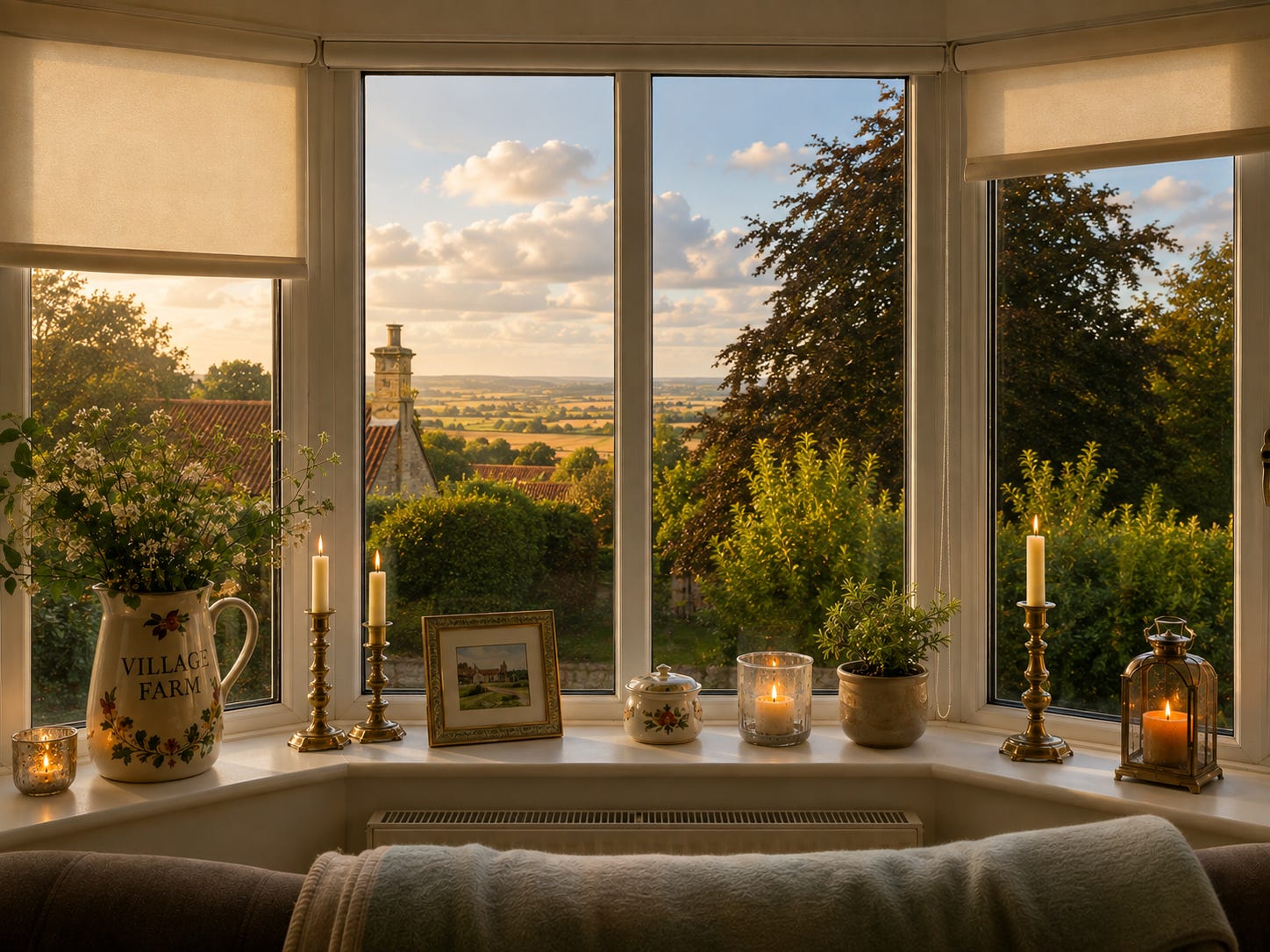
There are mornings when I stand in our granary kitchen, or out in the courtyard garden, mug of creamy coffee warming my hands, I inhale and try to imagine who stood in this exact spot three hundred years ago. I exhale.
That’s how old my house is.
Three hundred years old. So most likely… nobody was standing here. It was probably just wilderness on the edge of a great limestone escarpment, until one day someone thought, “We could farm this.”
The walls of the house are cool and calming, but they do creak and speak. It never feels empty. It carries too much life for that.
When we first walked through the door ten years ago, there was an immediate warmth to it. A feeling of safety. Of home. Only after we had a moving date did I discover that one of my closest friends had grown up in our farmhouse. She lived here from the age of five to ten and still remembers exactly how it was laid out. Her kitchen was at the front of the house, and her bedroom is now my ensuite bathroom.
Our kitchen was once a granary barn, connected to the farmhouse only by a small ante room, which I believe used to be a garage. My friend remembers her dad parking his old Volvo there.
The twenty-one-foot barn, however, housed tractors and grain. She remembers standing at the landing window, waving to the farm workers in the yard below.
Transforming it in 2018 gave me something I’d only ever dreamed of. It was my dad who stood in that empty space and said, “Wouldn’t this make an incredible kitchen? The heart of the home.”
My friend’s dad who parked his Volvo in our ante room and my beautiful dad never met, yet somehow, they’re both part of the same story.
I love that.
The room I now use as my office and library was the kitchen when we first arrived. But my friend remembers it being a snug. It makes me think this old farmhouse has spent three centuries playing pass the parcel with its rooms. Every family has unwrapped it differently, imagining new possibilities within the same old walls. Is that what old houses do? Lend themselves to each family that passes through. One generation sees a kitchen. Another sees a library or a music room, a workshop or a nursery. The walls stay the same, but the dreams inside keep changing.
I love my library. A huge red reading chair sits in the corner, surrounded by heavy oak bookcases that line the walls where kitchen cupboards used to be. The tartan carpet softens every footstep, but I know there are quarry tiles beneath it. It’s the room where I write, mark books, create lessons, dream up stories and lose afternoons writing memoirs.
Once upon a time, someone stood in my library after an argument, wondering whether to apologise. Someone has listened for the sound of children running across the yard. Someone has waited for a husband to return from the fields before darkness settled across the village. Someone has celebrated a birth. Another I’m sure has mourned a death. I’m certain I can’t be the only one who has cursed the damp.
Time behaves differently inside an old house. Three hundred years is almost impossible to comprehend; it has survived fashions, monarchs, wars, pandemics, storms, tractors replacing horses and the slow disappearance of the working farms that once stitched Lincolnshire together. The fields surrounding it have grown smaller. Bungalows and Grand-Design new builds now stand where livestock once grazed. Then you rest your hand against a wall built from rough quarry stone and remember that countless other hands have done the same. The walls of my home aren’t elegant, they crumble constantly (quite literally); they were never meant to impress anyone. They were built to endure.
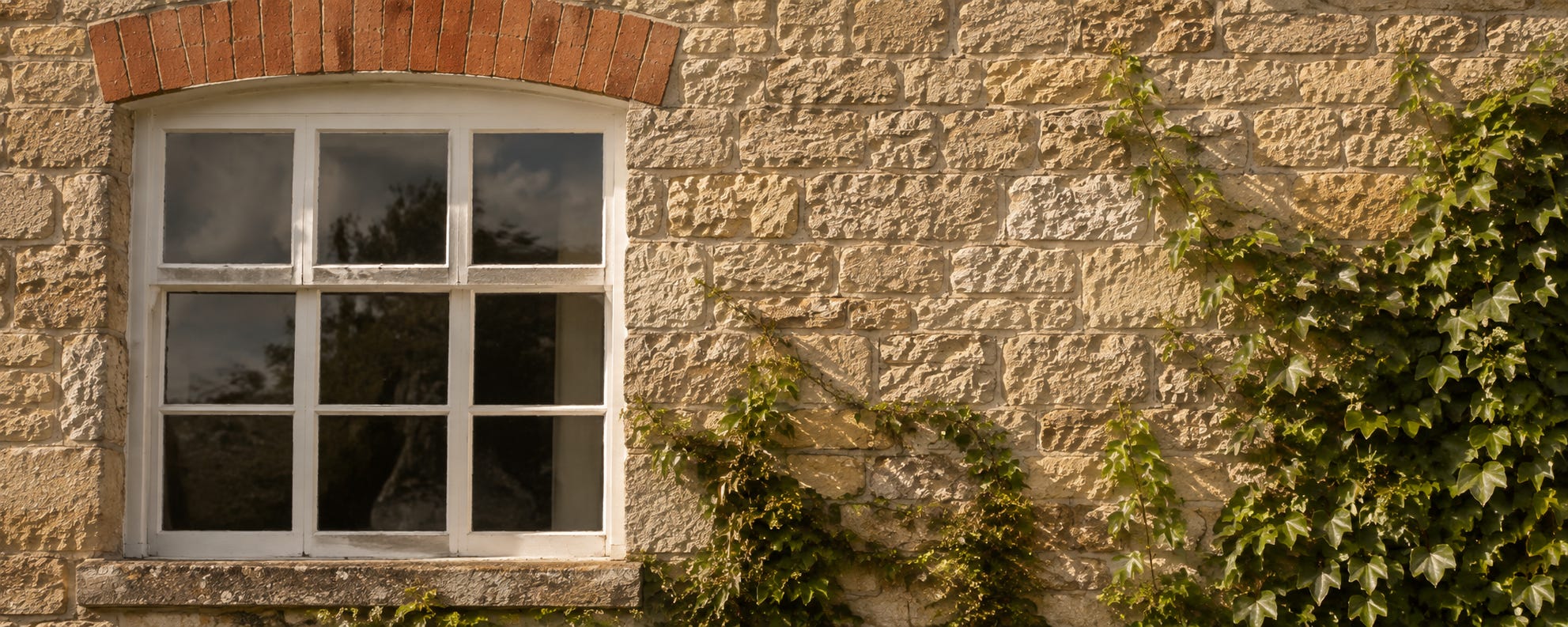
There is a cellar beneath us, cool and damp even in midsummer, with its own fireplace tucked into the stone as though someone once believed every corner deserved warmth. Every room above carries a fireplace too, reminders that this house was once heated by flames and not gas. Climb into the loft and another story reveals itself. A great hollow scar slices through the centre where an original chimney stack once rose from cellar to roof. It is impossible to ignore, a cavernous scar that leaves the rafters looking oddly unfinished.
When we bought this house, I thought we were simply buying somewhere to live. We wanted more space, a garden and an exciting home where our children could grow up and one day bring their own children back. (We’re not there yet.)
Instead, what we bought was an ongoing strongly worded conversation.
The windows and cills all needed replacing. The pointing between the stones has surrendered to weather and time. Damp has crept down forgotten chimney breasts forcing us to close some rooms off from daily life. Every improvement uncovered another layer of work waiting beneath it, another decision to be made by someone long before we arrived, another compromise, another repair, another story. Old houses are wonderfully resistant to the illusion of completion. So, we have become, as others have in the past, custodians of our home.
Even though we own Village Farm, I don’t think it belongs to us. In fact, I don’t think anyone can truly own a place like this.
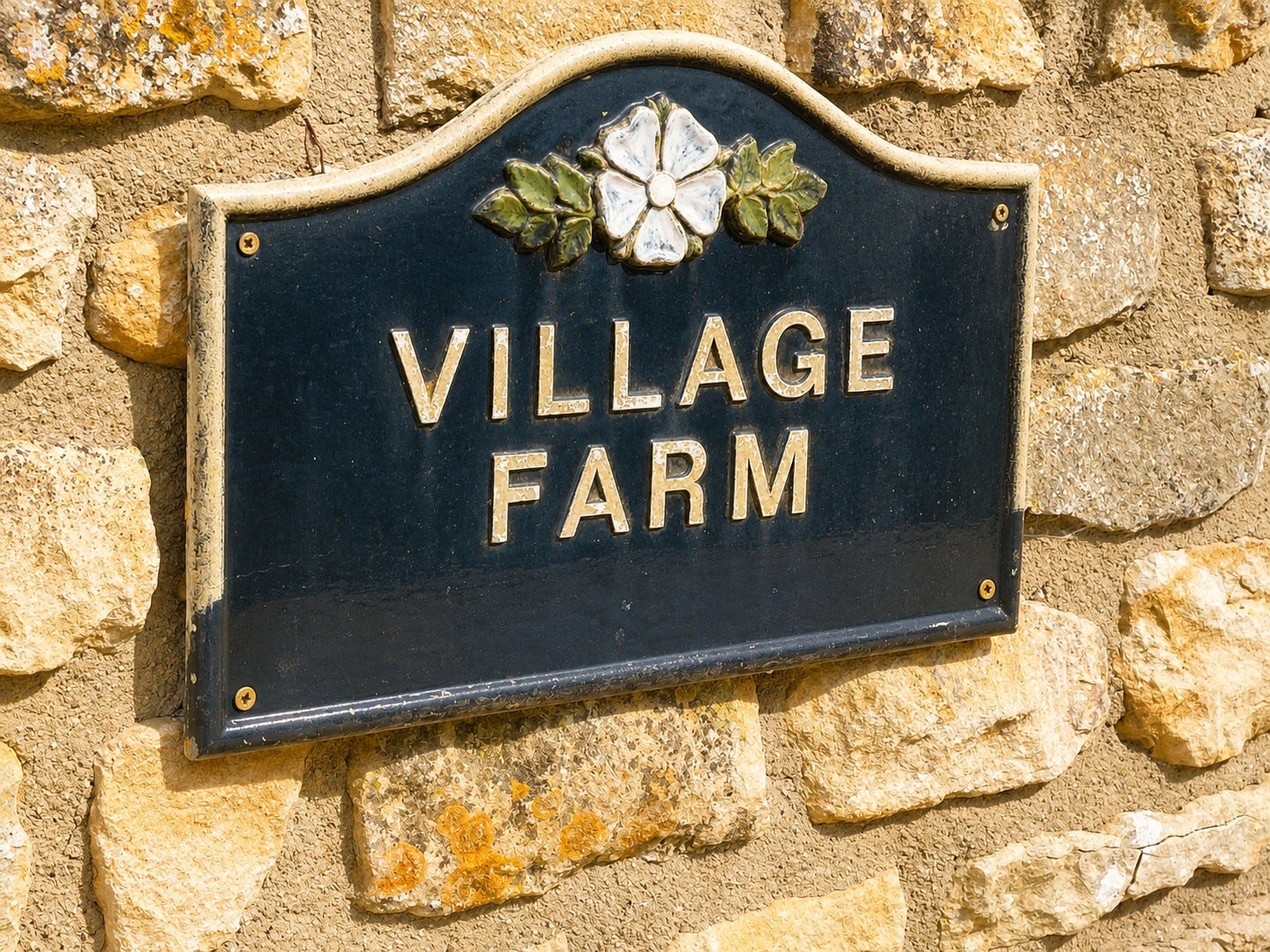
Three hundred years has surely taught the house not to believe in ownership. It has already outlived every family who has ever called it theirs. Deeds have changed hands. Names have disappeared from parish records. Children have grown old. It has been deserted and left derelict. Empires have risen and fallen. The house simply remained, waiting for the next key to turn in its door.
We speak so confidently about my house, my land, my garden. Yet history and age have a curious way of dismantling ownership and I’m sure will smile gently at our certainty. Long after we’re gone, someone else will stand or sit exactly where I’m sitting now to type these words, believing, for a little while, that these walls belong to them too.
Clearly history is what gives a place its soul.
Yet life, as life often does, has corrected me… again.
For years I believed that what I felt inside Village Farm, the sense of peace and security, came from its age. Three centuries would surely leave its mark. That’s what lingers in the stone, what settles beneath uneven floors and inside thick walls.
Then I began thinking about another house. Not one built in the eighteenth century, but one built little more than a lifetime ago. The house where my parents have lived for thirty years. The house where my children, and my brother’s and sister’s children, grew up. It’s where Dad died and where my brave mum is now preparing, painfully, to leave.
Carramore House.
It isn’t ancient. It was built around the turn of the twentieth century, a relative youngster compared to Village Farm. Its ceilings soar where ours stoop with low beams. Its doorways invite you in rather than asking you to duck. It hasn’t watched dozens of monarchs come and go, survived centuries of Lincolnshire winters, or stood stubbornly while storms erased neighbouring villages and castles from the landscape.
People don’t stop outside Carramore because of its age as they walk the Viking Way. If they pause at all, it’s because of its whitewashed face, the wisteria curling around the doorway each spring, or the quiet grace with which it sits in the rolling landscape. It is beautiful and loved. Some might even say, ordinary.
Yet...
I don’t know another house that carries more life or love or another house that is more extraordinary.
My parents moved to Carramore when I was seventeen. At first, it was simply another house: a bungalow attached for Grandie, a large garden where Dad could indulge his lifelong love of growing things, and plenty of space for young adults to roam and, eventually, grandchildren. We thought we were choosing a house where my parents would grow older. We had no idea we were choosing the backdrop to almost every family story we would tell for the next thirty years.
My memories of Carramore aren’t organised into special occasions. They have accumulated in the ordinary rhythm of family life.
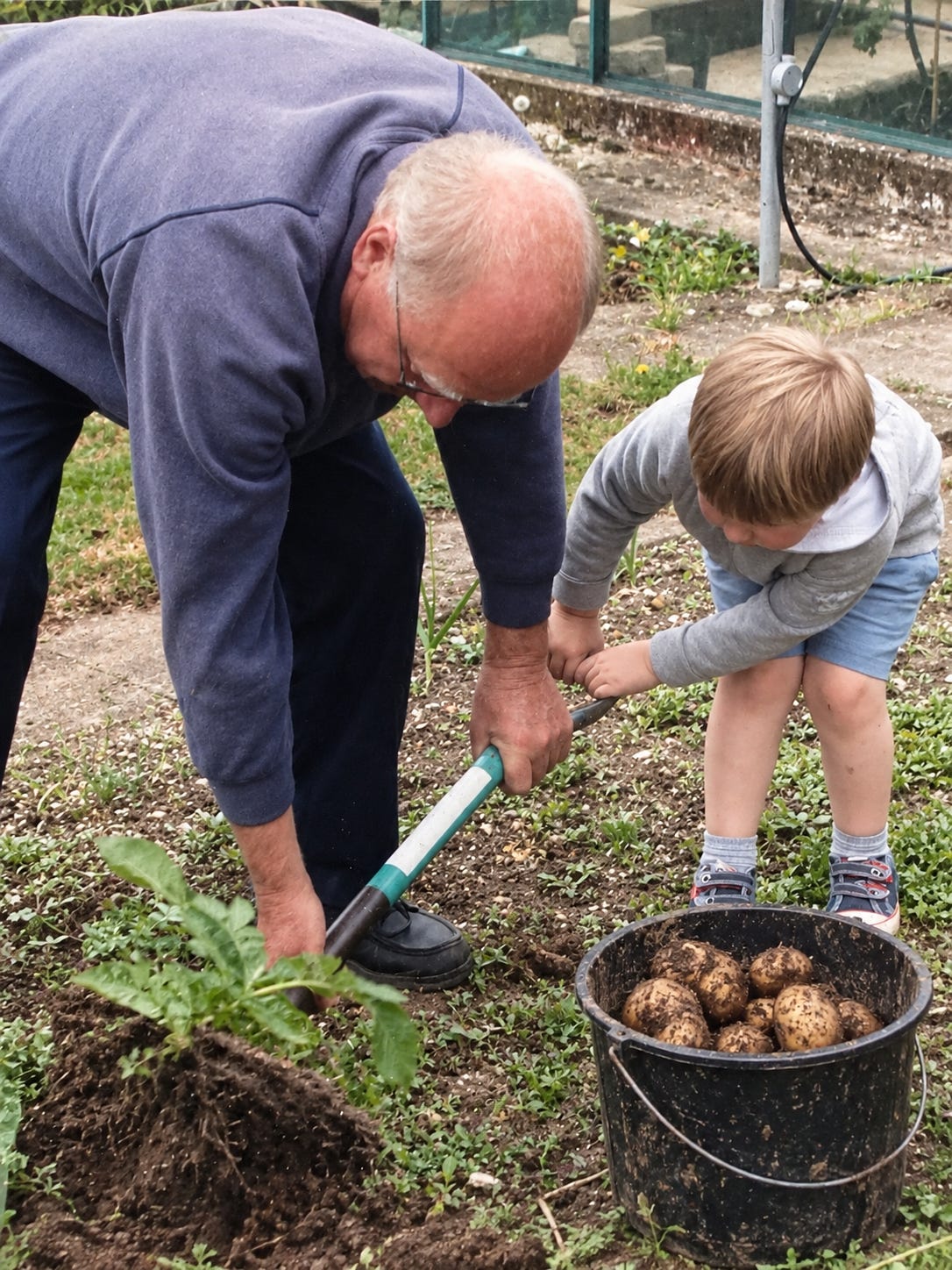
Autumn meant Grandad’s allotment. Little hands disappeared into the rich, dark soil, searching for potatoes that emerged like buried treasure, impossibly large and still fragrant with the damp earth that had hidden them.
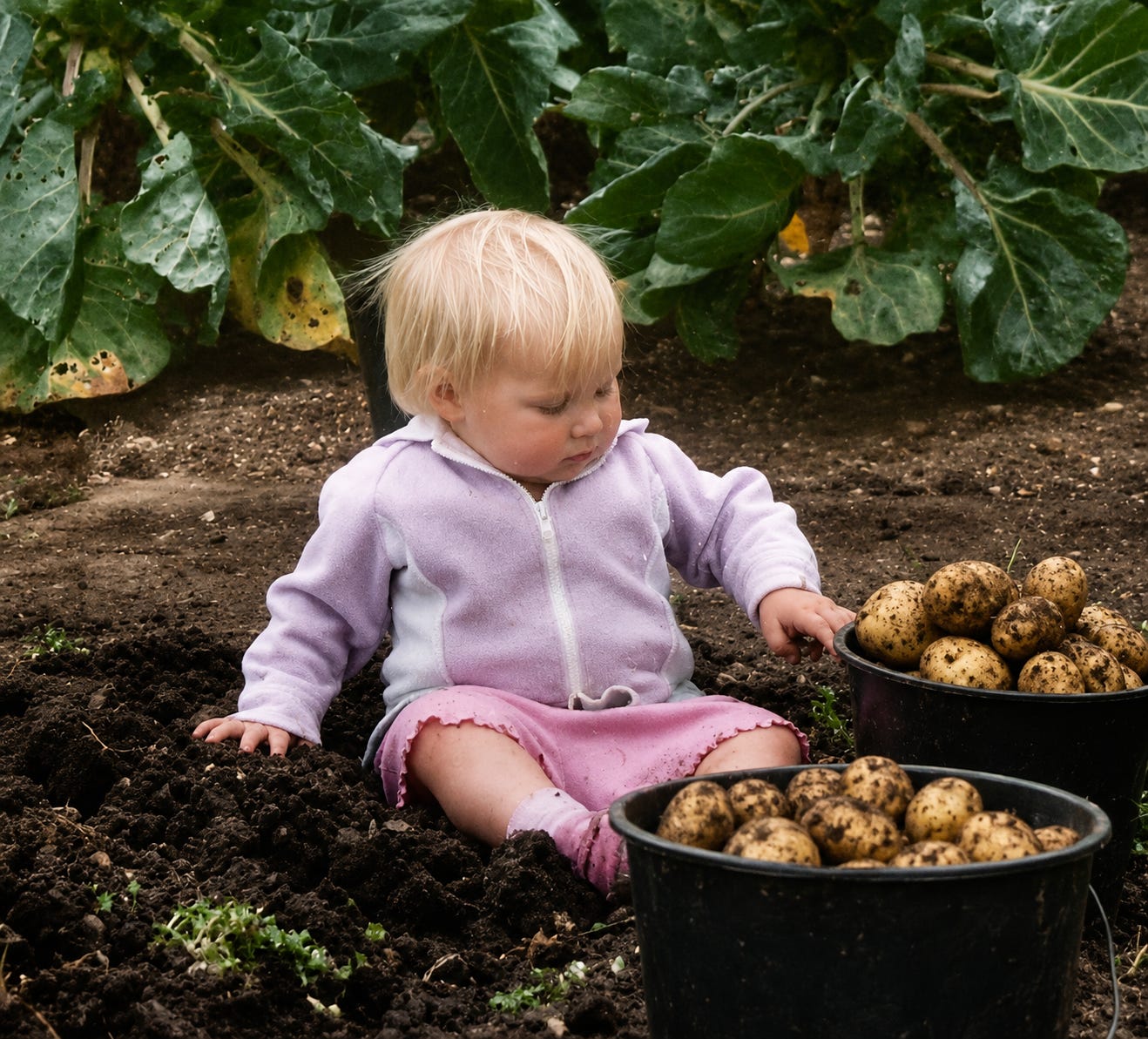
The orchard gave us apples that somehow tasted sweeter because we’d picked them ourselves. They were often crushed into bottles of cloudy cider and, like the plum trees, became the source of family folklore. To this day we still laugh about the summer the sweetest toothed grandchild cheerfully ate plum after plum, only to discover that each contained a wriggling worm.
The greenhouse was never just a greenhouse. It was Dad’s kingdom. Tomatoes stood proudly in neat rows while cucumbers, melons and grapes hung heavily from their vines, but what really grew there were conversations. Somehow, the ones that mattered always found their way beneath that glass.
It was in the potting shed next to the greenhouse that I told Dad I was pregnant with my first child. I can still see his face. He wrapped me in a hug before stepping back, his eyes glistening. I remember the quiet wave of relief that washed over me. He was happy. Excited, even.
“You always do things the wrong way round,” he said with a smile, every bit the old-fashioned father.
I laughed. A habit I still struggle to undo in life’s most intense moments.
“I didn’t realise there was a specific order when it came to love.”
For a moment he simply looked at me. Then he smiled again.
“What are you going to do?”
“I’m going to love it.” I told him.
He nodded gently and hugged me again, more tightly.
“There’s no better answer,” he whispered.
The potting shed fell quiet. Neither of us spoke for a while. We simply stood there, smiling through tears. Seed trays lined the benches, waiting patiently for spring, while somewhere a watering can dripped onto the concrete floor. Outside, the garden had settled into its winter sleep, but inside Dad was already preparing for another growing season. Looking back, it feels fitting that we had that conversation in a room devoted entirely to hope.
With hindsight, I now know what Dad was really asking. Not whether I loved my baby or my husband. He already knew that. He was wondering whether I’d be all right. Whether I’d be secure. Whether life might prove harder than I’d hoped. Whether the little girl he’d spent a lifetime protecting was ready to become a mother. My answer wasn’t really about the baby either. It was about the kind of parent I hoped to become.
Love first.
The rest, somehow, would find its place.
Of course, not every greenhouse memory was so profound.
Once, during an ambitious water fight, a handful of the grandchildren decided Dad’s carefully nurtured, slightly softening tomatoes made excellent ammunition. The ensuing telling-off has also become family folklore and is retold with increasing dramatic licence every time we’re together. By the following morning, peace had returned. Dad was back inspecting what was left of his plants, hose in hand, unable to stay cross for long.
Even now, the scent of warm tomato leaves is enough to take me back.
To him.
To Carramore.
The magpies came every morning as faithfully as the sunrise. We all counted them. The willow stretched over the swimming pool until one extraordinary day it finally surrendered to gravity, crashing into the water as though even trees eventually become tired of holding themselves upright. I know that feeling.
Summer holidays blurred into endless afternoons of dripping towels, wet footprints across patios, barbecues that always produced too much food, random guests, dogs (at least five) weaving between laughing children, and adults convinced they were keeping a watchful eye while losing themselves in conversation and wine. If you stayed until evening, which most people did, there was usually ice cream in the freezer.
Mostly Magnums.
Dad had a habit of appearing with them at exactly the right moment, as though he possessed an internal compass for happiness. He was a Magnum magnet.
None of us announced that memories were being made. No one paused to appreciate how ordinary, and extraordinary, it all was. We were simply living, and that, I have come to believe, is how larfulness gathers: the invisible presence that settles inside a place after years of ordinary living, until the walls begin to remember the people who have loved there. It is not something a house is built with; it is something a house earns.
Carramore House has certainly earned larfulness.
It doesn’t arrive through grand occasions or dramatic moments. It accumulates through repetition: one Sunday lunch after another; one bonfire (how Dad loved a bonfire); five o’clock Christmas mornings with wrapping paper strewn across the lounge, while Bucks Fizz and coffee went round; scraped knees and wasp stings; weddings with three tenors, muddy wellington boots abandoned by the back door after a dog walk in the Great Woods or down the dell; grandchildren measuring themselves against the same wall by the laundry room until, one day, they realised they were looking Nanna in the eye, and before long, Grandad too.
Love settles inside a house, so silently that you rarely notice it happening. Then one day you return after being away for a while, climb the familiar stairs, hear the creak you’ve heard a thousand times before, and realise the place seems to recognise you as instinctively as you recognise it. Houses absorb us in the same way old wooden tables absorb polish over decades, layer upon layer, until something invisible has been created that no architect could ever draw. A house is designed on paper, but a home is drawn by those who live in it.
Mum is living inside that feeling of larfulness now. She’s in the strange, uncertain space that comes before leaving a home. The sale inches forwards, then backwards. Some days she’s moving. Some days she isn’t. Every phone call seems capable of changing the future. It’s a season of thresholding. Standing between one version of life and another.
The practical part of moving house is, in theory, straightforward. There are skips to hire, boxes to find, cupboards to empty and decades of possessions to sort and label; keep, donate or throw away. There are endless phone calls, forms to complete, solicitors to chase, estate agents to negotiate with and the peculiar frustration of watching your future depend on paperwork inching back and forth between strangers’ desks. It is time-consuming, expensive and relentlessly stressful.
And yet, that is the easy part.
The emotional part of moving is anything but.
Yes, Carramore is where Mum and Dad spent thirty of their fifty-four years of marriage. It is where they welcomed sons and daughters-in-law into the family, where grandchildren arrived one by one, where birthdays, Christmases and anniversaries were celebrated, where horse chestnut trees were planted, horses were kept and gardens tended. But it is also where Dad became ill, where Mum cared for him with extraordinary devotion, and where, finally... he died.
Somehow, even writing those words feels impossible.
We know we aren’t leaving him behind when Mum moves. His ashes are with us. His stories have long since escaped the walls of Carramore and live in all our homes. He arrives whenever someone mentions dessert or family holidays. He appears in the way my children laugh, in the expressions we catch ourselves using because he used them first, and in the countless habits we’ve inherited without ever intending to. He isn’t contained by bricks and mortar.
We know that.
Grief, however, rarely listens to reason.
Sometimes it convinces us that leaving a place means leaving a person too, because the walls have become fluent in their voice and every room has learnt the rhythm of their footsteps.
Living at Village Farm has helped me understand something I don’t think I could have understood anywhere else. Its extraordinary age invited me to wonder about the families who stood here before us, whose laughter drifted through these rooms, whose grief these walls absorbed and whose fingerprints have long since disappeared from the stone.
One day we will become those people.
Now, as my mum slowly and tentatively prepares to leave Carramore, the home she and Dad filled with almost thirty years of ordinary life, can I finally see that all those years we were giving Carramore its soul. We were writing ourselves into its walls.
As young adults we filled it with noisy parties and impossible dreams. Then, almost without noticing, we became parents ourselves. Sunday lunches grew longer. Eight grandchildren arrived. Dad manicured his herbaceous borders while little hands helped deadhead and pull out the weeds. Summer meant trampolines, Frisbees and French cricket on the lawn. Bonfires glowed against autumn skies. Christmas mornings began before dawn.
None of it felt remarkable.
It was simply our life.
Until, one day, it became our history.
That, I think, is what Village Farm has been trying to teach me.
Not that old houses are special because they have survived.
They are special because generations of ordinary people filled them with extraordinary love.
History doesn’t give a house its soul. Love does. Age simply gives love longer to settle. Carramore never needed three hundred years. Thirty was enough.
One day Mum will close Carramore’s front door for the last time and leave behind the house that held thirty years of her life. She’ll carry boxes to another house, arrange familiar photographs on unfamiliar shelves and slowly learn the creaks, the light and the rhythms of somewhere new. And because she’s my mum, she’ll do what she’s always done. She’ll find the courage and carry on. Just as her mum did. Just as Dad’s mum did. Before the last box has been unpacked, she’ll already have begun making another house a home.
But Carramore won’t lose its larfulness the day she leaves. It will go on holding every conversation around the kitchen and dining table, every Easter egg hunt, every morning cuddle, every outdoor cat that wandered through its doors, every lawnmower ride, every final drink taken before the swing of the gate, and every version of our family that grew within its walls.
Carramore has earned them.
So, thank you, Carramore, for sheltering four generations of my family and many more besides. For giving Dad the dignity of spending his final weeks where he most wanted to be, surrounded by the people he loved and the view he never grew tired of. And thank you for giving my children a childhood richer than they could ever have known while they were living it.
Another exquisite piece Claire. Your writing is poetry. I felt myself almost inhabit each of the houses you describe, and even felt my heart touch into the love and loss that they/you have held. I welcomed the emergence of my own grief as you describe a kind of family life that I have never experienced in this lifetime. Except the `love and loss' parts of course. That too was a gift. thank you. I also felt your home sounded like an 'Elder' home in all its rich 300 year history and I related this to the home I have discovered inside myself....including the crumbling parts! Thank you so much for this piece Claire and for gifting it to us all so generously. I feel changed by it. xxx
Hello Claire, I loved reading this so much. It made me feel nostalgic for a family life I never had…but can appreciate the exquisite beauty of it in the way you tell it.
It feels like this is the makings of a book. ❤️